Garden Hose Holder
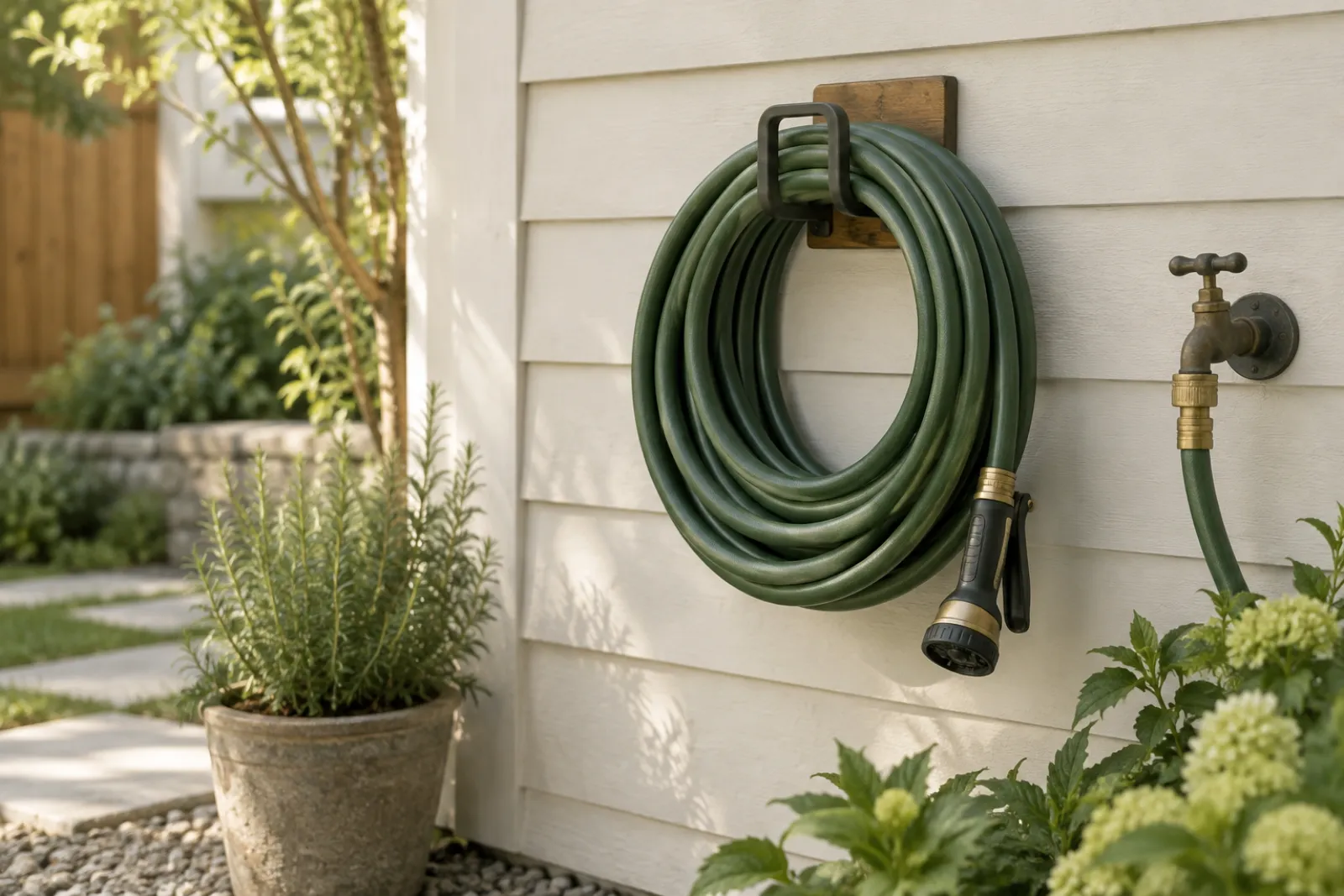
Wall-mounted garden hose holder with a neatly coiled hose on a house wall beside an outdoor spigot

Garden Hose Holder: Best Types, Materials & Storage Solutions Guide

A garden hose holder is the simplest fix for the least attractive corner of most properties. You know the one. A green pile by the spigot, half coiled, flattened where the mower ran over it, dripping at the connector every time somebody turns the tap. Put a proper hose holder there and two things change the same afternoon: the line comes off the grass, and your outdoor space stops looking half finished.

Stock and pricing on Amazon shift daily. Worth checking today's before you decide.

Garden Hose Storage Solutions for Every Yard

This page splits the market into four groups: wall-mounted hangers, freestanding stands, reel carts, and decorative pots. Each suits a different wall, a different yard, a different lease. You'll get the criteria that matter, a side-by-side table, and a durability checklist most roundups skip. Practical garden hose storage solutions, sorted by who they're actually for.

We earn a commission when you buy through the Amazon links on this page. It costs you nothing extra, and it doesn't change what ends up on the list.

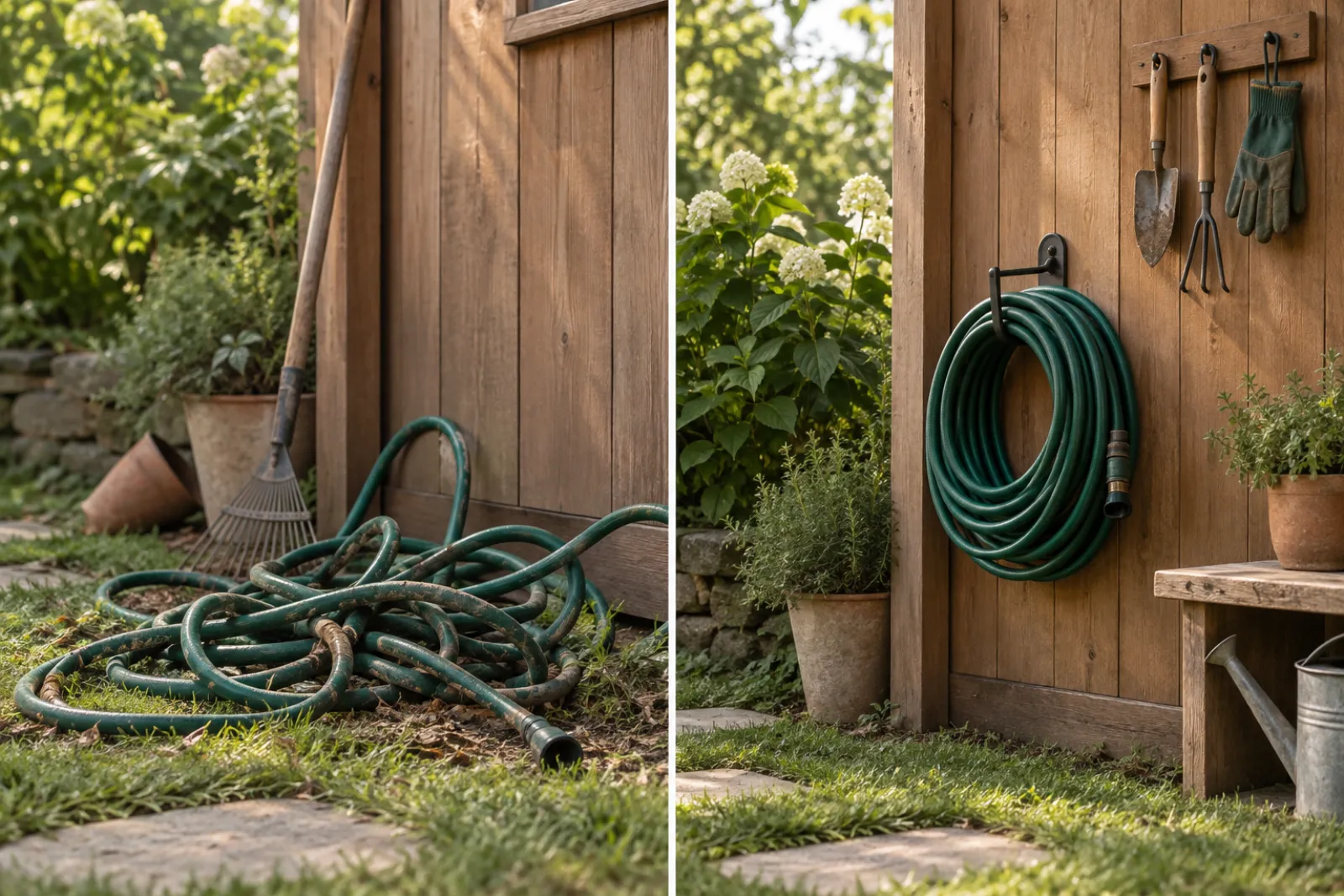
Before and after: a tangled garden hose on the lawn next to the same hose stored on a holder

Keep Your Garden Hose and Garden Tools Organized

Hose chaos isn't only cosmetic. A line left on the ground picks up grit, bakes in UV, and gets run over by everything with wheels. Get it up off the lawn and it lasts seasons longer. Same logic covers the rake and the pruners: storing hoses and garden tools in one fixed spot turns a fifteen-minute wrestling match into a five-minute watering job.

How a Tangled Hose Damages Your Garden and Wastes Water

Every tight bend leaves a memory in the rubber. Kink the same spot often enough and the inner tube starts to collapse, so water flow drops off even with the tap wide open. Then there's the collateral damage. A hose dragged across beds snaps stems, scrapes bark off young trees, and carves ruts through mulch. And the slow drip at the coupling, the one you stop noticing by July, runs for months. A few drops a minute is gallons a week, landing exactly where you don't want them.

Garden Hose Storage That Prevents Kinks, Leaks and Tangles

Storage that works does three things. It keeps rubber off wet soil, it holds a wide coil radius so the wall of the tube never folds, and it takes the strain off the brass fitting at the tap. That's what prevents kinks and tangles, and it's why a holder will extend its lifespan by years. A neat setup also means you actually drain the line before a freeze, because it takes thirty seconds instead of feeling like a chore.

Garden Hose Holder Buying Guide: What to Consider

Four things decide whether a holder lasts a decade or wobbles loose by August: what it's made of, how much line it swallows, how it attaches, and whether your hose type plays nice with it.

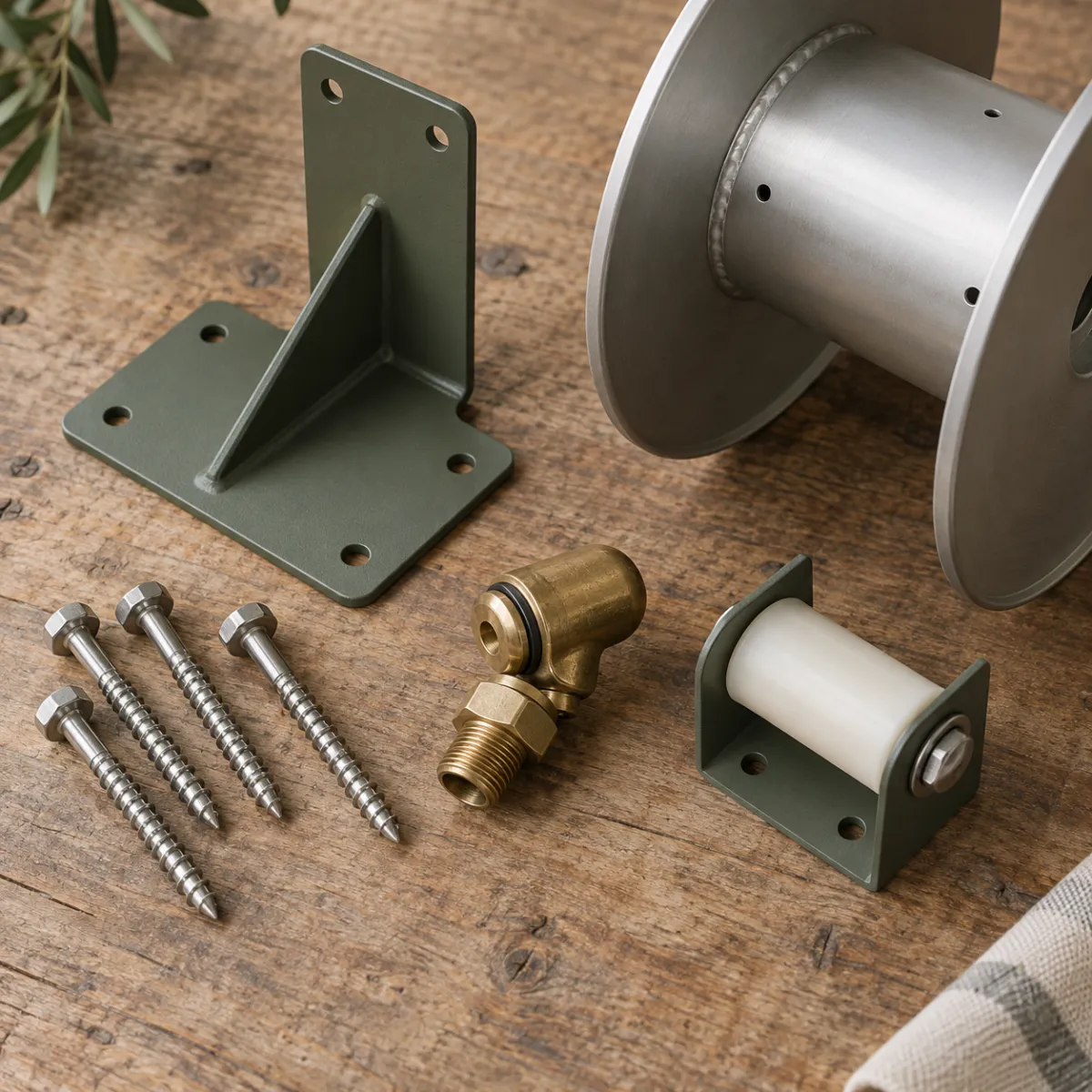
Close-up of powder-coated steel and aluminum garden hose holder parts, screws and a hose guide roller

Material & Durability: Steel, Aluminum & Heavy-Duty Coatings

Most of the good ones are made from powder-coated steel, and the coating is what does the work. Thinly painted steel starts weeping rust at the cut edges within a season or two, especially near irrigation spray or coastal air. Aluminum skips the problem and weighs less, which is why zero-rust aluminum reels (Gorilla builds a well-known upright version) sell hard in wet climates. Cast iron looks right on a brick wall and is genuinely heavy-duty, though you should touch up any chips before winter. Resin and plastic pots won't rust at all, but thin ones go brittle after a few hard freezes.

Check the hardware too. Makers save money on screws, and a durable bracket hanging on zinc-plated lag bolts will still streak your siding orange.
Hose Reel Capacity: How Many Feet You Can Store

Capacity is quoted in feet of 5/8-inch hose, the standard diameter for home use. Ratings run from roughly 75 feet on a small hanger to 400 feet on a full cart. Buy a size up from what you own: a holder rated exactly to your 100 feet will fight you on the last few turns, and 3/4-inch line eats capacity faster than the label suggests.

Mounting Type: Wall-Mounted, Freestanding or Portable by Preference

Less about specs, more about preference and permission. Fixed to a wall or fence, a stand you can shift, or something with wheels. Your water source settles most of it. If the outdoor water tap sits on the house and the beds are forty feet out, a cart saves you more walking than any bracket will.

DIY Installation and Hose Guides for Smooth Water Flow

Almost everything in this category is a DIY job. Two to four screws, a level, twenty minutes. On reels, look for hose guides at the outlet, the roller or slot that feeds the coil on evenly instead of letting it pile up on one side. Reels also run a short leader hose from the drum to the tap, and a brass swivel there keeps water flow steady while stopping the fitting from working loose as the drum turns.

Flexible Hose Compatibility With Every Holder Type

Here's what product pages don't tell you: an expandable hose does not belong on a tight-wound drum. It contracts when pressure drops, so it pulls against the reel and chafes. An open hanger, a basket, or a pot suits a flexible hose far better. Rubber and reinforced vinyl wind up fine.

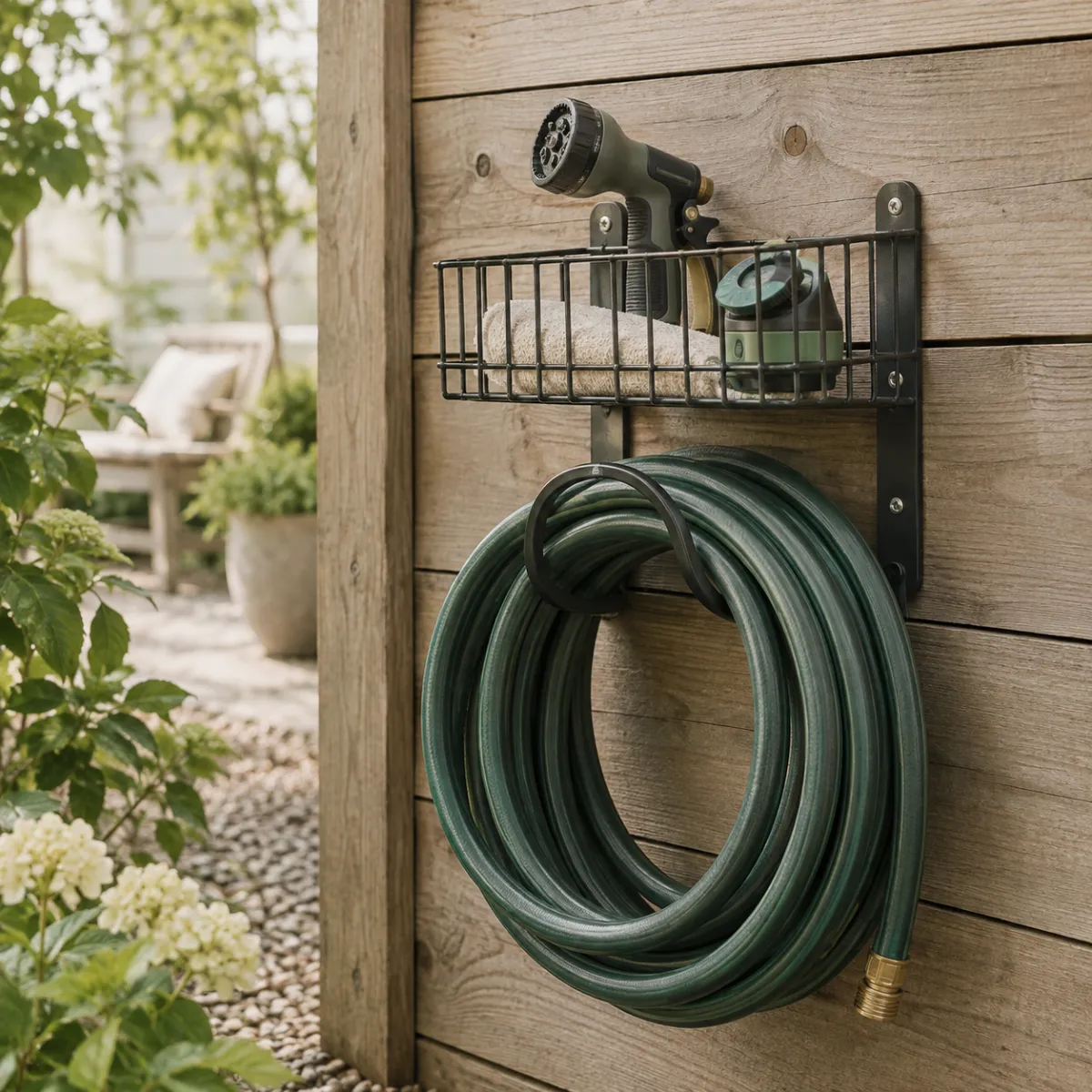
Steel hose hanger and rack mounted on a wooden fence with a nozzle basket on top

Wall-Mounted Garden Hose Holders

Hose Hanger and Rack Styles for Fences and Walls

Three shapes dominate. The plain hose hanger, a hook you loop the coil over. The rack, a wider bracket with a shelf or basket on top for nozzles and sprinklers. And the wall reel, a drum with a crank on the same footprint. A hanger is the least fussy option; a reel asks for more and repays you every time you put the line away.

Mounting matters more than the holder itself. Into siding, find a stud. Into brick or block, use masonry anchors rather than plastic plugs. On a fence, screw through the rails or add a backing board behind the pickets, since fence boards alone flex and pull. Drain the hose first, because a full 100-foot line is heavy enough to tear light anchors straight out of thin siding.

Best for Homeowners With a Fixed Water Source

If you own the place and the spigot isn't moving, shop this category first. A homeowner with a patio wall or garage wall near the tap gets the tidiest result for the least effort, and the holder stays put through wind, snow, and the lawn crew.

Check price on Amazon

Wall models sell out fastest in spring. Check current availability.

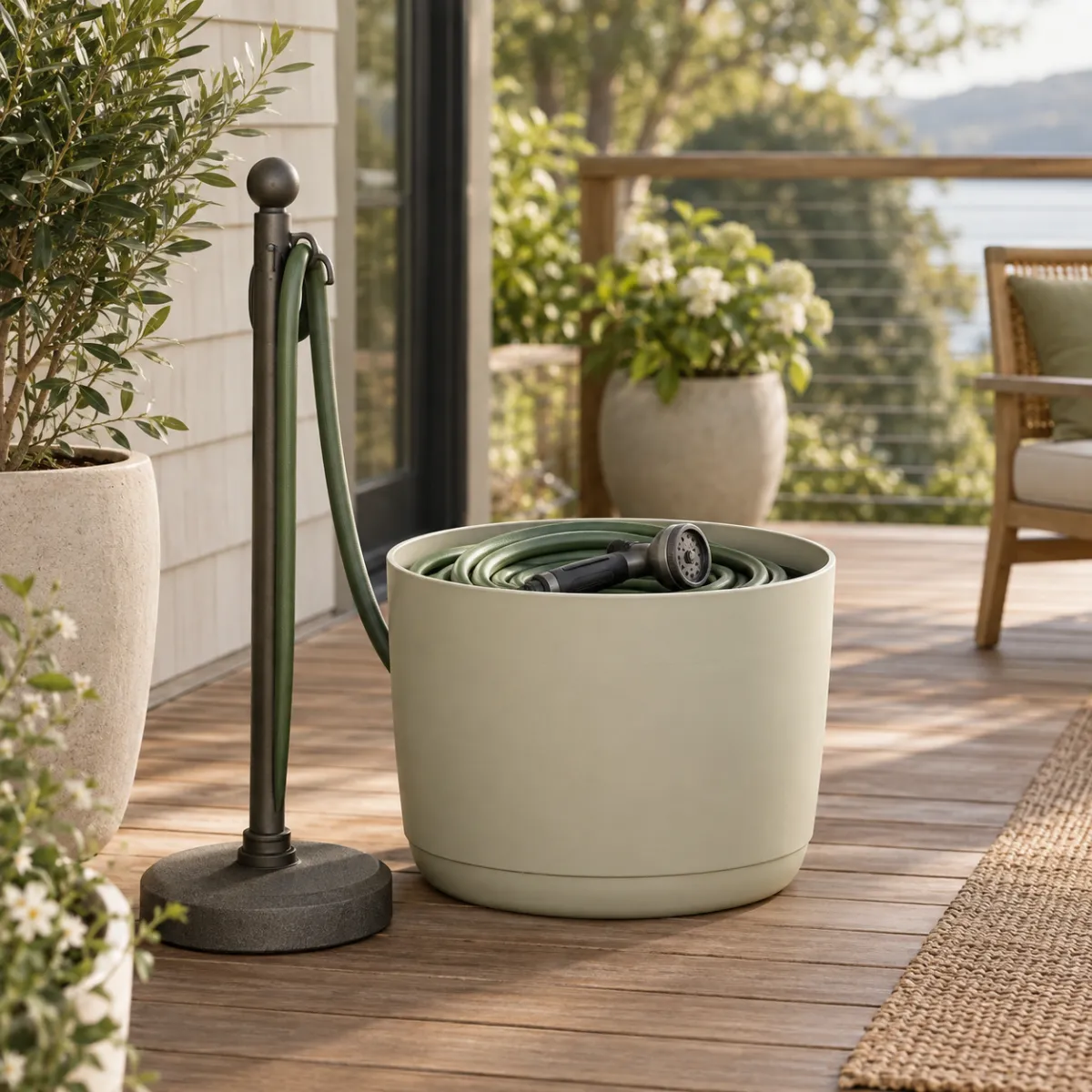
Freestanding no-drill hose stand and a resin hose pot on a wooden deck

Freestanding Garden Hose Holders for Renters

Portable, No-Drill Options for Patios and Decks

No drilling, no lease conversation, no patching holes when you move out. Freestanding stands come in two flavors: a stake type you drive into soil, and a weighted base that sits on a deck or slab. For an apartment balcony or a rented townhouse, the weighted base wins. Look for a wide footprint and a carry handle, because the portable ones move to wherever the watering happens that week and go back in storage after.

Some stands include their own spigot and a short leader hose, giving you a second water point out in the yard instead of a walk back to the house.

Hose Pot Designs That Save Space

A hose pot is an open-topped container with an opening at the back for the leader line. You coil inside it, drop the nozzle on top, and it disappears. Best pick for a small deck, since the footprint is the pot and nothing else, which saves more floor space than any bracket. It also handles expandable line without complaint. Ceramic versions crack in hard freezes, so bring them in; resin and metal can stay out.

Check price on Amazon

Renting? These ship ready to use. Check today's price.

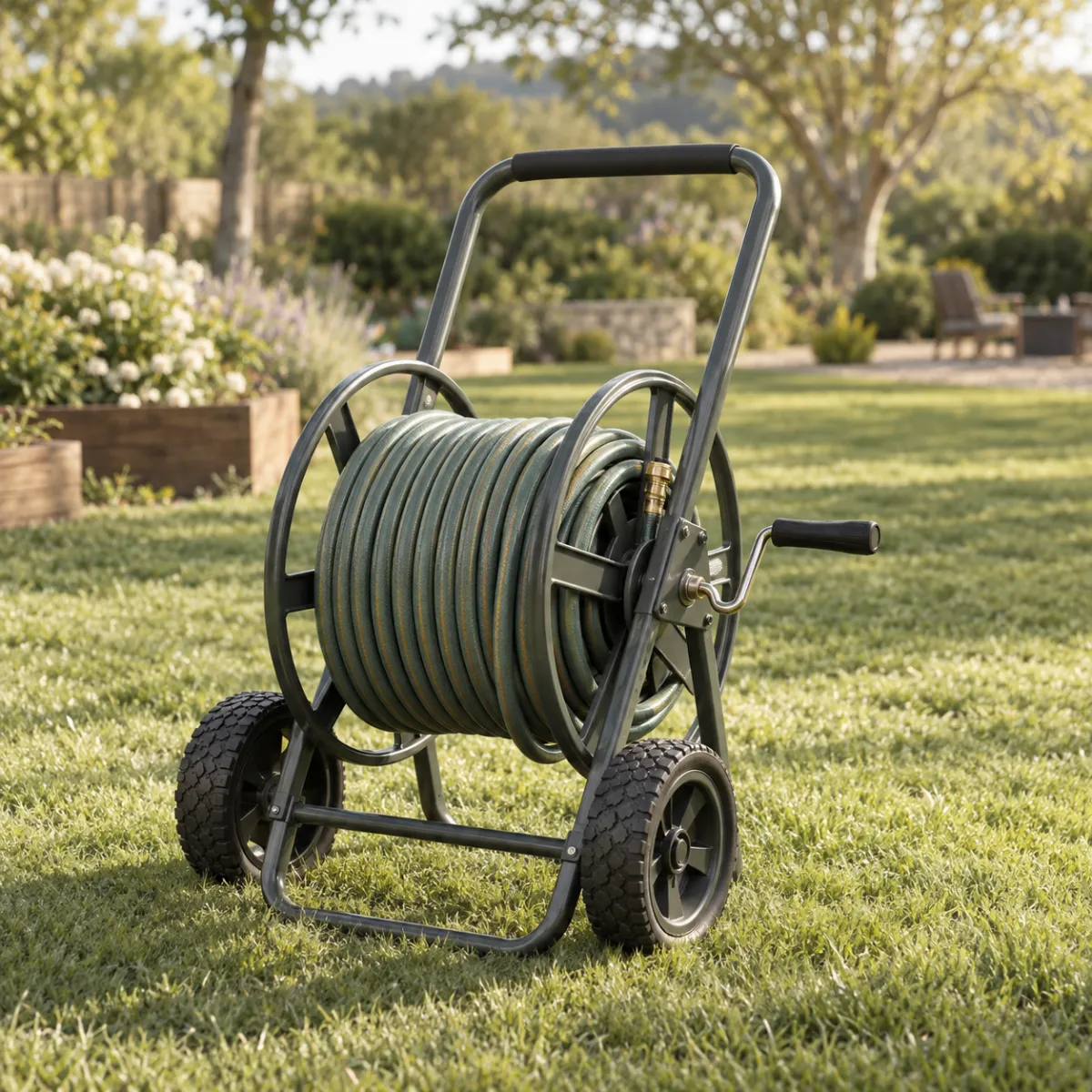
Wheeled garden hose reel cart with a crank handle standing on a large lawn

Garden Hose Reel Carts for Large Yards

Wheeled Carts That Prevent Kinks and Tangles

A cart is a reel on a frame with a handle, and on a big property it changes the job entirely. You wheel the whole thing out to the far beds instead of dragging 200 feet of rubber behind you. Because garden hose reels wind the line onto a drum under tension, hose reel carts prevent kinks and tangles better than any other format.

Wheel size is the spec people get wrong. Small casters dig into turf and stall at the first tree root. Look for wheels in the 8 to 10 inch range with real tread if your ground is soft or uneven. A wide crank helps too, since rewinding a long line with a stubby knob gets old fast.

Hose Carts With 300+ Feet of Capacity

The largest hose carts take 300 to 400 feet, which covers most acre-plus lots in one setup. Yard Butler quotes capacities from 75 up to 400 feet across its range, and that span is typical for a garden hose reel cart. Check loaded weight before you commit: full of water, a big one is a two-hand push on any slope, and it needs somewhere to park in the off-season.

Check price on Amazon

Capacity ratings vary by hose diameter. Check the current listing specs.

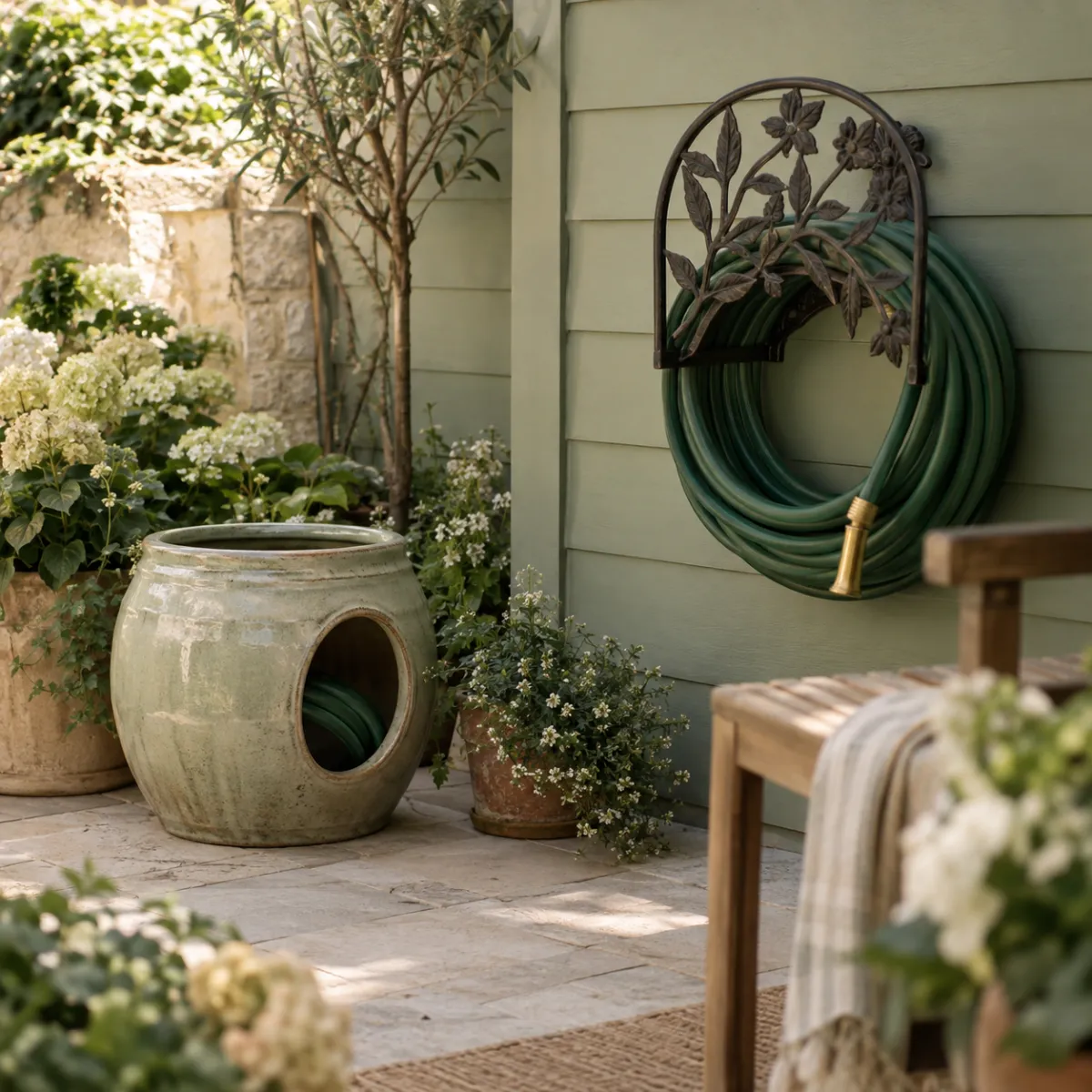
Decorative cast iron hose holder with leaf motif and a ceramic hose pot on a small patio

Decorative Hose Holders for a Stylish Backyard

Garden Hose Holders That Come in Different Designs

Looks and function stopped being a trade-off a few years back. Garden hose holders come in different designs now: cast iron wall pieces with leaf and bird motifs, powder-coated stands in real colors instead of builder beige, copper that ages to verdigris, resin pots molded to pass for planters. Brands like Fritz Tango built an entire line on the idea that a decorative hose holder should look deliberate rather than industrial.

The test is simple. Stand where you see the spigot from most often, usually a kitchen window. If the setup reads as an eyesore from there, a stylish holder earns its place every day, not just on watering day.

Compact Pots for Small Patios and Balconies

Small spaces get the most from the pot format. A compact pot in a corner holds 50 feet of line, doubles as a side table with a tray on top, and keeps a backyard or terrace reading as a room rather than a utility area. Functional and good-looking at once, which is the whole point.

Check price on Amazon

Colorways and finishes sell through quickly. Check what's in stock.

Garden Hose Holder Comparison: Type, Capacity and Best Use

Wall-Mounted vs Freestanding vs Cart vs Decorative

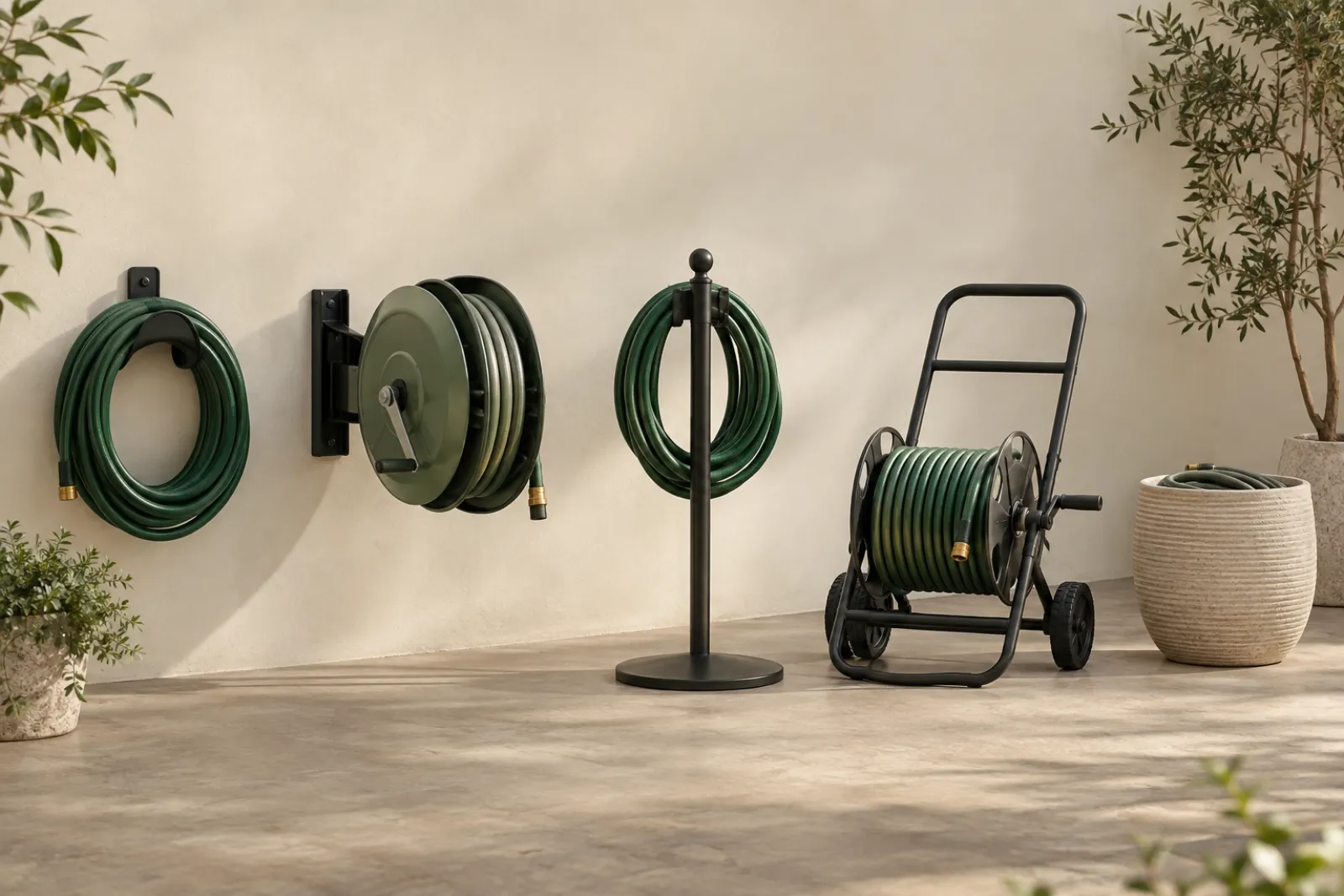
Four garden hose holder types side by side: hanger, wall reel, freestanding stand and reel cart
Garden hose holder types compared by capacity, materials, drilling, best use and price tier
Type Typical capacity Common materials Drilling Best for Tier Action
Hanger / rack 75–150 ft Coated steel, cast iron Yes Owners, small to mid yards Budget Check price
Wall reel 100–200 ft Steel, aluminum, resin Yes Owners who rewind daily Mid Check price
Freestanding stand 100–200 ft Steel, aluminum No Renters, decks, slabs Budget–mid Check price
Reel cart 200–400 ft Steel frame, resin drum No Large yards, long runs Mid–premium Check price
Pot / decorative 50–125 ft Resin, ceramic, copper, iron Sometimes Balconies, visible corners Mid–premium Check price
Check price on Amazon

— capacities and finishes vary by listing.

Which Type Ensures the Best Fit for Your Yard

Two questions settle it. Can you drill? If not, you're choosing between a stand, a cart, and a pot. How far is the farthest plant from the tap? Under about 75 feet, a fixed holder by the spigot is fine. Beyond that, wheels ensure you aren't hauling wet rubber across the lawn twice a week. Renters with a small yard should start with the pot or the stand. Owners with a large yard and long runs almost always end up happier with a cart. That's how you choose the right format before you start comparing brands.

Garden Hose Holder Testing: Durability, Leak and Rust Checks

None of the big retail pages ranking for this term stress-test what they sell, so here's the protocol worth running yourself during the return window.

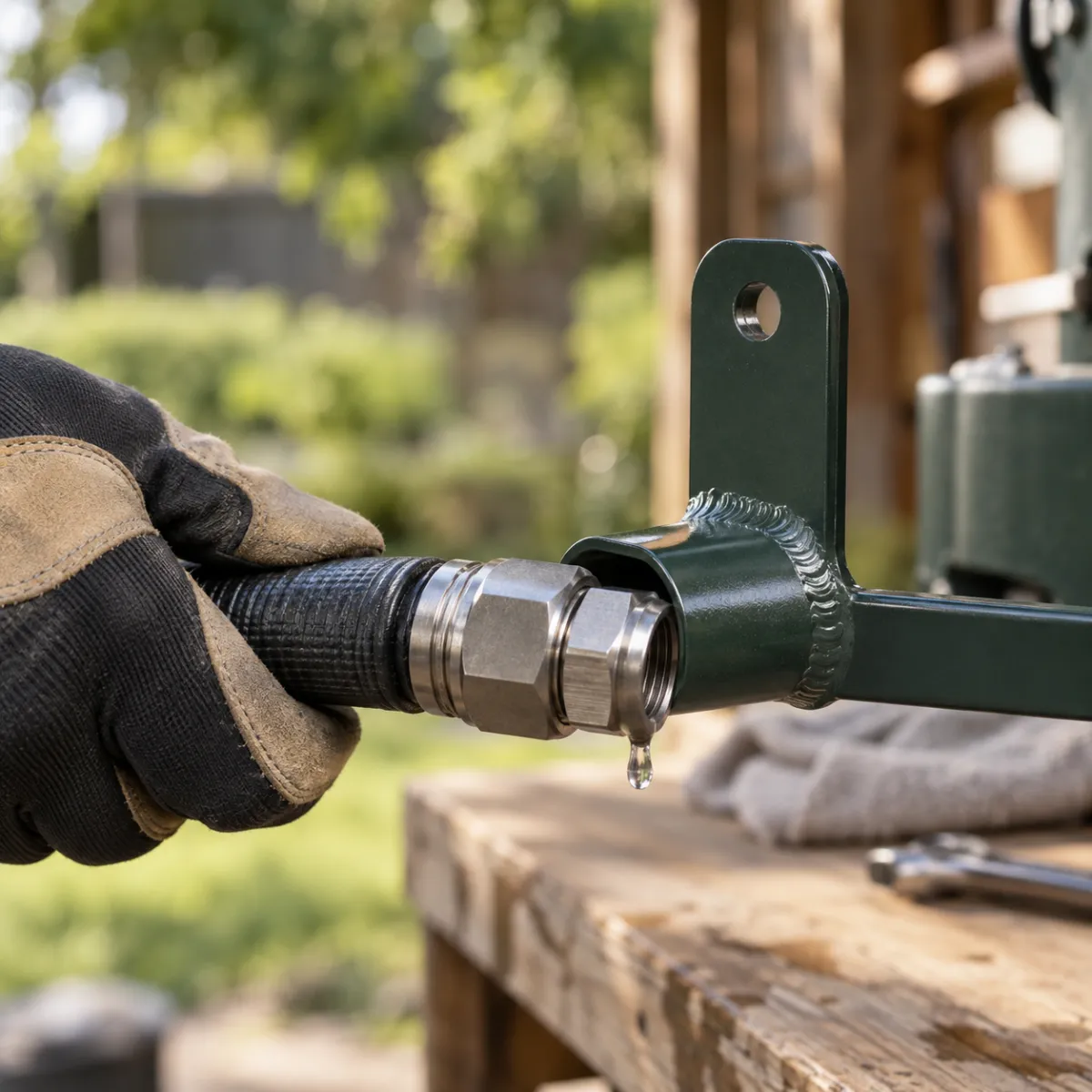
Hands checking a hose reel swivel fitting for leaks and inspecting a bracket for rust
  1. Loaded weight. Hang or wind the hose charged with water, then watch where the bracket meets the wall. Visible flex or a gap means the anchors or the bracket are undersized.

  2. Leak check. Pressurize and look at two spots: the swivel where the leader meets the reel body, and the inlet fitting. Anything that weeps now weeps worse after a winter.

  3. Rust check. After the first heavy rain, inspect cut edges, weld seams and screw heads. Coatings are thinnest there, and that's where corrosion starts.

  4. Crank under load. Rewind a full line. If the handle binds or the drum walks sideways, the bearing is cheap.

  5. Freeze check. Trapped water in a drum or pot is a crack waiting for the first hard frost.

Handy Features That Extend the Life of Your Hose

A few handy details earn their keep: a guide roller designed to make rewinding a one-handed job, a brake so the drum doesn't spin free, a basket for the nozzle and timer, a leader hose in the box. Each one removes sharp bends, and sharp bends are what shorten the life of your hose.

Weatherproof, Rust-Resistant Materials That Last

Weatherproof means the whole assembly, not just the frame. Coated steel with stainless hardware and a resin or aluminum drum stays out year-round in most climates. Warranty language tells you what the maker believes: Yard Butler runs a lifetime warranty registration program on its steel products, and that kind of commitment is a fair proxy for durability when you can't handle the item before buying.

Check price on Amazon

Compare warranty terms and current ratings on the listing.

Hose Holder Installation and Off-Season Storage Tips

Step-by-Step Wall and Fence Mounting

Installation runs about twenty minutes with a drill and a level.

  1. Hold the holder against the wall at roughly hip height and mark the holes. Higher and the coil drags; lower and it sits in splash.
  2. Find the stud, or on masonry drill for sleeve anchors sized to the supplied lag screws.
  3. Drill pilot holes one size under the screw shank so the thread bites.
  4. Run a bead of exterior sealant into each hole on siding so water stays out of the wall cavity, then drive the screws and snug the last quarter turn by hand.
  5. Hang the drained hose and lean on the bracket. Better to find a weak anchor now than in October.

Fence mounting adds one step: a backing board behind the pickets so the load spreads across two rails. Straightforward DIY either way.

Winterizing Your Garden Hose Reel for the Off-Season

Shut the indoor valve feeding the outdoor tap and open the bleeder. Disconnect the water hose, then walk its length uphill to push the water out, or drape it over a rail for an hour. Coil it loosely, never tight. Drain the drum and any pot holding standing water. Store the line in a shed or garage where it stays above freezing; the holder itself can stay mounted if it's rated for it. Skipping the drain step is how a good reel splits its housing by February.

Check price on Amazon

Off-season is the quiet time to buy. Check the current price.

Garden Hose Holder FAQ

Garden hose coiled in wide loops on a holder next to a spigot and nozzle
What is the best garden hose holder for a small yard?

A wall hanger or a pot. Both take 50 to 100 feet without eating floor space, and neither needs the clearance a cart does. Pick the pot if you can't drill.

What is a garden hose holder called (hanger, reel, or hose pot)?

All three, depending on shape. A hanger or rack is a bracket you loop the coil over. A reel has a crank and a drum. A hose pot is a container the line lives inside. Retailers also use "hose butler" and "hose organizer" for the same things.

What's the best way to store a garden hose without kinks or tangles?

Drain it, coil it in wide loops in one direction, and keep it off the ground. Wide radius is the whole trick. Tight loops are what set permanent bends into the tube.

Can I mount a wall-mounted hose holder without drilling into the wall?

Not reliably. Adhesive and strap mounts don't hold a wet line long term. If drilling is off the table, a freestanding stand or a pot gets you the same result with zero holes.

What materials are garden hose holders made from (steel, aluminum, or plastic)?

Coated steel is most common, aluminum is the rust-proof upgrade, cast iron shows up on decorative wall pieces, and plastic or resin is standard on carts and pots. Hardware quality varies more between models than the frame material does.

What is the hose capacity of a typical garden hose reel cart?

Most carts take 200 to 400 feet of 5/8-inch hose. Thicker 3/4-inch line cuts that noticeably, so read the rating against what you actually own.

How should I store my garden hose reel during the off-season or winter?

Drain the line and the drum completely, coil loosely, and move it indoors or into a shed. Shut off and bleed the outdoor supply. Trapped water is what cracks housings.

What's the easiest way to keep your garden organized with a hose holder?

Give the hose one fixed home beside the tap and add a rack with a basket for the nozzle, timer and sprinkler. Once the small parts have a place, the line gets put back properly, and that's what keeps your garden organized and the yard tidy without you thinking about it.

Are these hose holders compatible with any garden hose brand, including Yard Butler reels?

Standard 5/8-inch and 3/4-inch hoses with normal GHT threads fit essentially any holder, Yard Butler included. The exception is expandable line, which suits hangers and pots better than tight-wound drums.

How easy is it to install a garden hose holder yourself?

Most are a genuine DIY job. Mark, drill, screw, done in under half an hour. Stands and carts need only assembly, usually a few bolts and a wheel axle.

Check price on Amazon

Shop garden hose holders that match your setup and see what's in stock today.

Organized backyard corner with the garden hose stored on a holder and garden tools in place

Ready to Organize Your Garden Hose

One holder, twenty minutes with a drill, and the pile by the tap is gone for good. Wall hanger if you own the place, stand or pot if you rent, cart if the property is big, decorative if the spigot sits in your sightline. Whichever type matches your space and watering needs, look for a rust-resistant finish, capacity above your hose length, and a warranty the maker is willing to put in writing. A good gardener buys the holder once.

Amazon pricing and stock change daily. Check today's before you order.

Check price on Amazon